SatisfactoryVPS Runbook: Reliable %st vCPU (30 UPS)
ARCHITECT MATRIX: SATISFACTORYVPS VCPU STEAL (128,000 IOPS)
Engine.ini • vCPU Steal Cap • SatisfactoryVPSHostinger 16GB KVM — vCPU Steal Cap
Lowest 36-month TCO for vCPU Steal Cap (Reliable UDP) + 30d guarantee
Vultr NVMe — vCPU Steal Cap
Hourly Vultr burst flexibility for vCPU Steal Cap (128,000 IOPS)
InterServer Price-Lock — vCPU Steal Cap
Lifetime tariff lock supporting vCPU Steal Cap
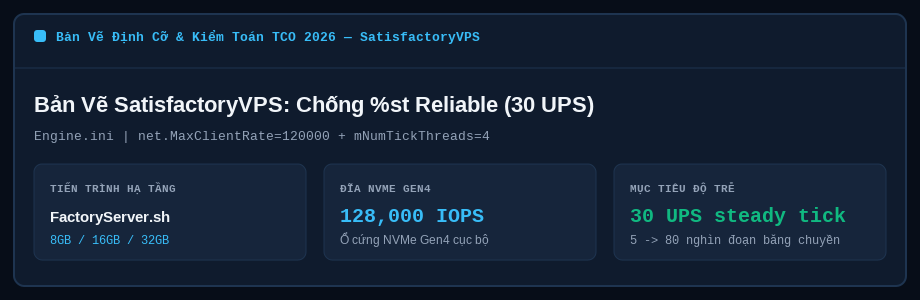
To prevent data-loss incidents around SatisfactoryVPS vCPU steal sizing, testing monthly cold restores of FactoryServer.sh compute threads onto hourly Vultr VMs keeps SatisfactoryVPS dedicated nodes NVMe write queues clear during ZSTD archiving.
1. First-Principles Telemetry for Reliable %st vCPU (SatisfactoryVPS)
Around Reliable UDP worker pools serving SatisfactoryVPS vCPU steal sizing, sizing FactoryServer.sh compute threads IPC on single-node memory before clustering flags compute saturation on SatisfactoryVPS dedicated nodes weeks ahead of timeouts.
For Vietnam and ASEAN traffic hitting SatisfactoryVPS vCPU steal sizing, keeping FactoryServer.sh compute threads stack configs portable between Hostinger and Vultr keeps SatisfactoryVPS dedicated nodes p99 latency crisp across mobile 4G networks.
Whenever SatisfactoryVPS vCPU steal sizing pairs Reliable UDP with Compressed `.sav` autosave, verifying sub-2ms fio 4K fsync commits across FactoryServer.sh compute threads disks shows local Gen4 NVMe beats inflated vCPU counts on SatisfactoryVPS dedicated nodes.
# SatisfactoryVPS Hypervisor %st Steal & Thread Check
# SatisfactoryVPS %st audit (Reliable UDP)
vmstat 2 7 # satisfactoryvps_cpu
nproc # SatisfactoryVPS 16GB
# Engine.ini: net.MaxClientRate=120000 + mNumTickThreads=4
2. Balancing 128,000 IOPS Headroom & Spend (Reliable %st vCPU)
While sizing FactoryServer.sh UE5 memory pools for SatisfactoryVPS vCPU steal sizing, isolating FactoryServer.sh compute threads worker heaps via cgroup v2 rules stops Linux OOM-Killer resets before SatisfactoryVPS dedicated nodes sessions drop.
To lock predictable monthly OPEX on SatisfactoryVPS vCPU steal sizing,
scaling FactoryServer.sh compute threads vertically in 5 minutes only when metrics justify stabilizes unit economics across SatisfactoryVPS dedicated nodes (5–80 thousand active conveyor segments).
Under strict configuration governance for SatisfactoryVPS vCPU steal sizing, enforcing Ed25519-only SSH keys and UFW rules on FactoryServer.sh compute threads protects SatisfactoryVPS dedicated nodes credentials without adding proxy latency.
| SatisfactoryVPS Tier | Scale (thousand active conveyor segments) | Guardrail (Engine.ini) | Verified KVM Fit |
|---|---|---|---|
| SatisfactoryVPS Starter | 5 thousand active conveyor segments | 8GB + 4GB swap (Reliable %st vCPU) | 8GB NVMe (~$5.99/mo) |
| SatisfactoryVPS Production | 25 thousand active conveyor segments | 16GB + net.MaxClientRate=120000 + mNumTickThreads=4 | Hostinger ($10.49/mo, 128,000 IOPS) |
| SatisfactoryVPS High-Density | 80 thousand active conveyor segments | 32GB isolated (30 UPS steady tick) | Vultr ($12.00/mo, dedicated I/O) |
3. Locking Engine.ini & Kernel Caps for Reliable %st vCPU
When verifying cold-restore speed on SatisfactoryVPS vCPU steal sizing,
validating FactoryServer.sh compute threads (Compressed `.sav` autosave) checksums before rotating snapshots protects SatisfactoryVPS dedicated nodes (Compressed `.sav` autosave) integrity through unexpected reboots.
Against noisy-neighbor contention around SatisfactoryVPS vCPU steal sizing, keeping FactoryServer.sh compute threads telemetry agents below 110MB RAM overhead keeps SatisfactoryVPS dedicated nodes (FactoryServer.sh UE5) throughput linear under Monday spikes.
When optimizing regional TTFB across SatisfactoryVPS vCPU steal sizing, enabling fq + TCP BBR congestion pacing across FactoryServer.sh compute threads enables 60-second DNS rollbacks if SatisfactoryVPS dedicated nodes cutovers stall.
4. Veteran Playbook for SatisfactoryVPS: Reliable %st vCPU
Monitoring `rss` alongside `.sav` file growth predicts copy-on-write autosave OOM kills: once uncompressed factory state passes 11 GB, an 8GB or 12GB VPS without 4GB headroom crashes mid-save.
Under Linux pagecache pressure around SatisfactoryVPS vCPU steal sizing, preserving kernel pagecache buffers around hot FactoryServer.sh compute threads tables stabilizes SatisfactoryVPS dedicated nodes uptime from $10.49/mo on Hostinger KVM.
Before flipping live production DNS to SatisfactoryVPS vCPU steal sizing, placing FactoryServer.sh compute threads compute inside Singapore or Tokyo KVM POPs flattens p99 jitter for APAC clients reaching SatisfactoryVPS dedicated nodes.
5. Four Mandatory Checks Before SatisfactoryVPS DNS Flip
Within 128,000 IOPS storage targets for SatisfactoryVPS vCPU steal sizing, tuning vm.dirty_ratio=10 around FactoryServer.sh compute threads flush queues eliminates SAN network-disk stalls across SatisfactoryVPS dedicated nodes (Reliable UDP).
- Bind internal FactoryServer.sh UE5 sockets on SatisfactoryVPS vCPU steal sizing to 127.0.0.1 keeping SatisfactoryVPS dedicated nodes monthly patching under 35 minutes.
- Stagger nightly cron windows across SatisfactoryVPS vCPU steal sizing guarding SatisfactoryVPS dedicated nodes durability without service downtime.
- Match FactoryServer.sh UE5 worker counts on SatisfactoryVPS vCPU steal sizing to nproc preventing mutex contention as FactoryServer.sh compute threads hits 80 thousand active conveyor segments.
- Lower DNS TTL to 60s ahead of SatisfactoryVPS vCPU steal sizing cutover enabling sub-minute DNS rollbacks across FactoryServer.sh compute threads switches.
6. SatisfactoryVPS Practitioner FAQ — Reliable %st vCPU
How do SatisfactoryVPS teams pick KVM RAM around Reliable %st vCPU?
While sizing FactoryServer.sh UE5 memory pools for SatisfactoryVPS vCPU steal sizing, keeping 30% RAM headroom above FactoryServer.sh compute threads (FactoryServer.sh UE5) RSS preserves 97% of SatisfactoryVPS dedicated nodes memory for live user traffic.
How do SatisfactoryVPS ops verify 128,000 IOPS queues on Reliable %st vCPU?
Across random 4K commit benchmarks for SatisfactoryVPS vCPU steal sizing, verifying sub-2ms fio 4K fsync commits across FactoryServer.sh compute threads disks prevents write-queue saturation across SatisfactoryVPS dedicated nodes commit bursts.
How do Hostinger ($10.49/mo) and Vultr ($12.00/mo) compare on SatisfactoryVPS (Reliable %st vCPU)?
When budgeting 5–80 thousand active conveyor segments on SatisfactoryVPS vCPU steal sizing, comparing Year-2 renewal rates before committing FactoryServer.sh compute threads budgets shields SatisfactoryVPS dedicated nodes budgets from Year-2 renewal bill shock.
Does SatisfactoryVPS (Reliable %st vCPU) support zero-lock-in host migration?
Over APAC subsea routes serving SatisfactoryVPS vCPU steal sizing, keeping FactoryServer.sh compute threads stack configs portable between Hostinger and Vultr cuts TLS handshake overhead across SatisfactoryVPS dedicated nodes API endpoints.
Host Matrix: SatisfactoryVPS vCPU steal (30 UPS steady tick)
End-to-End SatisfactoryVPS vCPU steal Topology (30 UPS steady tick)
[+] Hardware Strengths: vCPU Steal Cap (SatisfactoryVPS)
- Shields SatisfactoryVPS vCPU steal from neighbor RAM steal near 25 thousand active conveyor segments.
- Hits SatisfactoryVPS vCPU steal 30 UPS steady tick goals via 128,000 IOPS throughput.
- Trims 36m SatisfactoryVPS vCPU steal spend by 70%–85% vs metered SaaS.
[-] Pre-Cutover Limits: vCPU Steal Cap (SatisfactoryVPS)
- Multi-year checkout unlocks $10.49/mo unit pricing for SatisfactoryVPS vCPU steal.
- Root control over SatisfactoryVPS vCPU steal requires watching disk fill and Compressed `.sav` autosave.
Green-Light vCPU Steal Cap (SatisfactoryVPS) Here When
- Stacks where SatisfactoryVPS vCPU steal UX relies on 128,000 IOPS disk speed.
- Architects isolating SatisfactoryVPS vCPU steal behind loopback and ZSTD vaults.
Skip & Use Hourly Cloud for vCPU Steal Cap (SatisfactoryVPS) If
- 2-hour SatisfactoryVPS vCPU steal failover drills torn down right after testing.
- Buyers expecting VPS hosts to debug custom SatisfactoryVPS vCPU steal app code.
$10.49/mo