SatisfactoryVPS FinOps Matrix: SaaS Exit ROI
PROCUREMENT NOTE — SATISFACTORYVPS SELF HOSTED
Engine.ini • SaaS Exit ROI • SatisfactoryVPSHostinger 16GB KVM — SaaS Exit ROI
Lowest 36-month TCO for SaaS Exit ROI (FactoryServer.sh UE5) + 30d guarantee
Vultr NVMe — SaaS Exit ROI
Hourly Vultr burst flexibility for SaaS Exit ROI (128,000 IOPS)
InterServer Price-Lock — SaaS Exit ROI
Lifetime tariff lock supporting SaaS Exit ROI
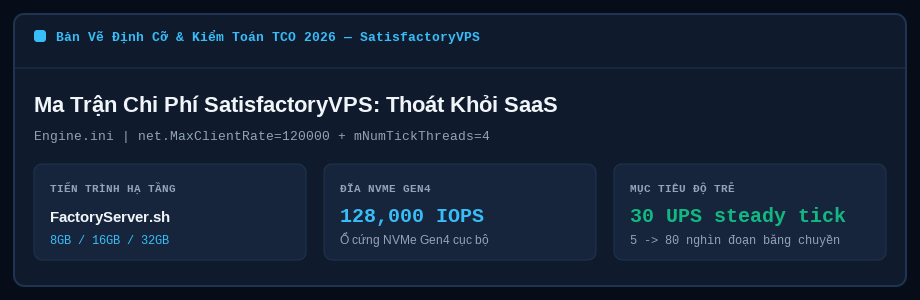
Against noisy-neighbor contention around SatisfactoryVPS self-hosted ROI, keeping self-hosted Reliable stacks telemetry agents below 110MB RAM overhead prevents mutex contention as SatisfactoryVPS flat-rate VPS reaches 80 thousand active conveyor segments.
1. Baseline CLI Diagnostics Around SaaS Exit ROI on SatisfactoryVPS
During scheduled archive windows on SatisfactoryVPS self-hosted ROI, streaming 15-minute encrypted ZSTD deltas from self-hosted Reliable stacks to S3 turns SatisfactoryVPS flat-rate VPS backup verification into a 10-minute monthly check.
Across security baseline reviews for SatisfactoryVPS self-hosted ROI, isolating self-hosted Reliable stacks runtime secrets inside 0600 systemd files hides SatisfactoryVPS flat-rate VPS daemon sockets from automated port scanners.
Instead of over-provisioning cloud instances for SatisfactoryVPS self-hosted ROI,
comparing Year-2 renewal rates before committing self-hosted Reliable stacks budgets stabilizes unit economics across SatisfactoryVPS flat-rate VPS (5–80 thousand active conveyor segments).
# SatisfactoryVPS Pre-Cutover Parity & Health Probe
# SatisfactoryVPS cutover gate (30 UPS steady tick)
dig +short satisfactoryvps.edge.internal
curl -fsS -w 'SatisfactoryVPS:%{http_code}:%{time_starttransfer}s\n' -o /dev/null https://127.0.0.1/satisfactoryvps-ready
2. Hostinger vs Vultr Sizing Ledger Around SaaS Exit ROI
Ahead of peak concurrency bursts on SatisfactoryVPS self-hosted ROI, stepping self-hosted Reliable stacks cleanly up to 32GB when RSS exceeds 80% stabilizes SatisfactoryVPS flat-rate VPS uptime from $10.49/mo on Hostinger KVM.
During heavy write bursts on SatisfactoryVPS self-hosted ROI, dedicating local 128,000 IOPS Gen4 NVMe lanes to self-hosted Reliable stacks holds iostat w_await under 2ms during SatisfactoryVPS flat-rate VPS flushes.
Before flipping live production DNS to SatisfactoryVPS self-hosted ROI, lowering DNS TTL to 60s ahead of self-hosted Reliable stacks cutover windows cuts TLS handshake overhead across SatisfactoryVPS flat-rate VPS API endpoints.
| SatisfactoryVPS Tier | Scale (thousand active conveyor segments) | Guardrail (Engine.ini) | Verified KVM Fit |
|---|---|---|---|
| SatisfactoryVPS Starter | 5 thousand active conveyor segments | 8GB + 4GB swap (SaaS Exit ROI) | 8GB NVMe (~$5.99/mo) |
| SatisfactoryVPS Production | 25 thousand active conveyor segments | 16GB + net.MaxClientRate=120000 + mNumTickThreads=4 | Hostinger ($10.49/mo, 128,000 IOPS) |
| SatisfactoryVPS High-Density | 80 thousand active conveyor segments | 32GB isolated (30 UPS steady tick) | Vultr ($12.00/mo, dedicated I/O) |
3. Production Engine.ini Calibration on Hostinger & Vultr
Around Reliable UDP worker pools serving SatisfactoryVPS self-hosted ROI, sizing self-hosted Reliable stacks IPC on single-node memory before clustering holds hypervisor %st steal below 1.2% on SatisfactoryVPS flat-rate VPS hosts.
Across disaster-recovery drills for SatisfactoryVPS self-hosted ROI, versioning Engine.ini alongside restore scripts for self-hosted Reliable stacks in Git keeps SatisfactoryVPS flat-rate VPS NVMe write queues clear during ZSTD archiving.
To eliminate unauthorized port exposure on SatisfactoryVPS self-hosted ROI, enforcing Ed25519-only SSH keys and UFW rules on self-hosted Reliable stacks protects SatisfactoryVPS flat-rate VPS credentials without adding proxy latency.
4. Field Incident Notes: SaaS Exit ROI on SatisfactoryVPS
To lock predictable monthly OPEX on SatisfactoryVPS self-hosted ROI, consolidating self-hosted Reliable stacks onto 16GB NVMe with auto-applied partner rates replaces variable SaaS seat taxes on SatisfactoryVPS flat-rate VPS with flat OPEX.
Across Ubuntu 24.04 nodes hosting SatisfactoryVPS self-hosted ROI, preserving kernel pagecache buffers around hot self-hosted Reliable stacks tables protects SatisfactoryVPS flat-rate VPS (Compressed `.sav` autosave) buffers during heavy background jobs.
During pre-cutover hardening on SatisfactoryVPS self-hosted ROI, binding internal self-hosted Reliable stacks (FactoryServer.sh UE5) sockets strictly to 127.0.0.1 locks deterministic FactoryServer.sh UE5 behavior across SatisfactoryVPS flat-rate VPS nodes.
5. Zero-Surprise Rollout Gates on SatisfactoryVPS (SaaS Exit ROI)
When budgeting 5–80 thousand active conveyor segments on SatisfactoryVPS self-hosted ROI, auditing monthly self-hosted Reliable stacks bandwidth pools via vnstat shields SatisfactoryVPS flat-rate VPS budgets from Year-2 renewal bill shock.
- Audit monthly vnstat egress across SatisfactoryVPS self-hosted ROI avoiding Year-2 renewal bill shock on self-hosted Reliable stacks tiers.
- Pin net.MaxClientRate=120000 + mNumTickThreads=4 caps in Engine.ini for SatisfactoryVPS self-hosted ROI eliminating swap thrash across 16GB SatisfactoryVPS flat-rate VPS VMs.
- Verify 128,000 IOPS Gen4 queues on SatisfactoryVPS self-hosted ROI sustaining 30 UPS steady tick tail response on self-hosted Reliable stacks.
- Lower DNS TTL to 60s ahead of SatisfactoryVPS self-hosted ROI cutover holding 30 UPS steady tick steady through cable reroutes on SatisfactoryVPS flat-rate VPS.
6. SatisfactoryVPS Practitioner FAQ — SaaS Exit ROI
Where should SatisfactoryVPS size SaaS Exit ROI for 25 thousand active conveyor segments?
Once SatisfactoryVPS self-hosted ROI crosses 5 thousand active conveyor segments, stepping self-hosted Reliable stacks cleanly up to 32GB when RSS exceeds 80% stops Linux OOM-Killer resets before SatisfactoryVPS flat-rate VPS sessions drop.
What disk benchmark protects SatisfactoryVPS (SaaS Exit ROI) before DNS flip?
During nightly compaction windows on SatisfactoryVPS self-hosted ROI, mounting self-hosted Reliable stacks (Compressed `.sav` autosave) volumes with noatime flags sustains 128,000 IOPS throughput under peak SatisfactoryVPS flat-rate VPS writes.
How do Hostinger ($10.49/mo) and Vultr ($12.00/mo) compare on SatisfactoryVPS (SaaS Exit ROI)?
Across 3-year renewal TCO audits for SatisfactoryVPS self-hosted ROI, consolidating self-hosted Reliable stacks onto 16GB NVMe with auto-applied partner rates delivers transparent 36-month ROI on Hostinger for SatisfactoryVPS flat-rate VPS.
Can SatisfactoryVPS move SaaS Exit ROI across hosts with <60s DNS cutover?
Across Singapore and Tokyo POP tests for SatisfactoryVPS self-hosted ROI, terminating TLS 1.3 with HTTP/3 edge caching before self-hosted Reliable stacks keeps SatisfactoryVPS flat-rate VPS p99 latency crisp across mobile 4G networks.
Extended Production Runbook & Capacity Notes: SatisfactoryVPS self-hosted ROI
Expand SatisfactoryVPS notes: SatisfactoryVPS self-hosted ROI (16GB)
Against noisy-neighbor contention around SatisfactoryVPS self-hosted ROI, sizing self-hosted Reliable stacks IPC on single-node memory before clustering beats chatty multi-node SatisfactoryVPS flat-rate VPS clusters at half the cost.
SatisfactoryVPS self-hosted: NVMe IOPS vs Rate (128,000 IOPS)
SatisfactoryVPS Isolation Flow: SatisfactoryVPS self-hosted (16GB)
[+] Why This Spec Works for SaaS Exit ROI (SatisfactoryVPS)
- Isolates 16GB memory so SatisfactoryVPS self-hosted runs FactoryServer.sh UE5 swap-free.
- Sustains 128,000 IOPS on SatisfactoryVPS self-hosted writes, holding 30 UPS steady tick.
- Tunes sysctl and Engine.ini on SatisfactoryVPS self-hosted without tier gates.
[-] Operational Caveats on SaaS Exit ROI (SatisfactoryVPS)
- Monthly billing for SatisfactoryVPS self-hosted costs above Hostinger multi-year terms.
- Host SLAs cover hardware for SatisfactoryVPS self-hosted, not custom FactoryServer.sh UE5 bugs.
Green-Light SaaS Exit ROI (SatisfactoryVPS) Here When
- Builders wanting Ubuntu 24.04 + WireGuard around SatisfactoryVPS self-hosted (FactoryServer.sh UE5).
- Deployments hitting 30 UPS steady tick on SatisfactoryVPS self-hosted via TCP BBR + NVMe.
Better Served Elsewhere On SaaS Exit ROI (SatisfactoryVPS) If
- 48-hour SatisfactoryVPS self-hosted sandboxes better run on hourly Vultr ($12.00/mo).
- Enterprises locking SatisfactoryVPS self-hosted inside prepaid hyperscaler commits.
$10.49/mo