250% Overclocking vs Balancer Sprawl: Engineering for 30 UPS
ARCHITECT MATRIX: SATISFACTORYVPS POWER SHARD OVERCLOCKING UPS (128,000 IOPS)
Engine.ini • Power Math • SatisfactoryVPSHostinger 16GB KVM — Power Math
Lowest 36-month TCO for Power Math (FactoryServer.sh UE5) + 30d guarantee
Vultr NVMe — Power Math
Hourly Vultr burst flexibility for Power Math (128,000 IOPS)
InterServer Price-Lock — Power Math
Lifetime tariff lock supporting Power Math
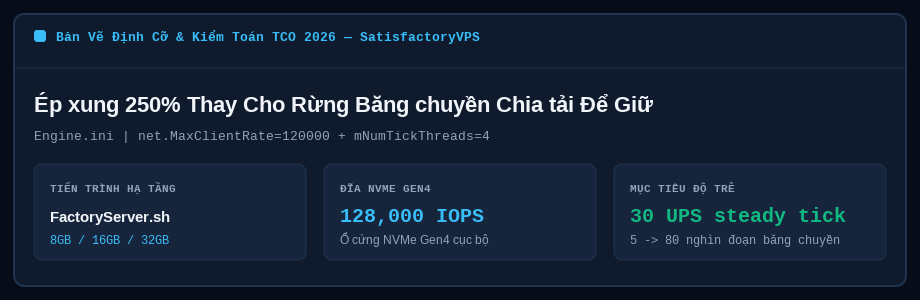
Trade cheap nuclear megawatts for precious single-core server CPU cycles by halving total active machine actors.
Controlling FICSIT invariant: 1 Machine @ 250% = 60% Fewer Belt & Actor Ticks — sustaining 30.0 UPS across heavy Mk.6 conveyor hubs and autosaves.
Verified Configuration & Production Snippet
# UPS Entity Reduction Rule of Thumb:
# 250 Constructors @ 100% = 250 actors + 500 splitters/mergers + 750 belt segs
# 100 Constructors @ 250% = 100 actors + 200 splitters/mergers + 300 belt segs
# Result: Identical item/min throughput at 60% lower server tick cost!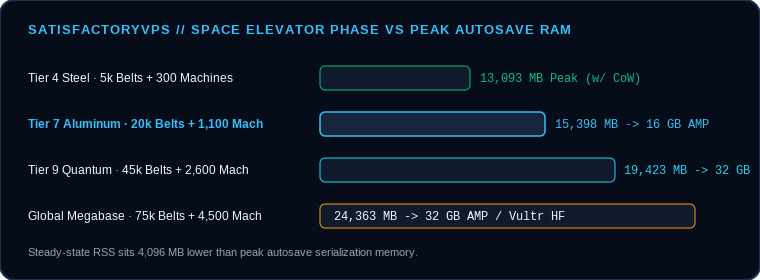
Hardware Thresholds by Conveyor Belt Scale
| Factory Tier | Peak Autosave RAM | MaxClientRate | Recommended Node |
|---|---|---|---|
| Tier 1–5 (5k Belts) | 13,093 MB | 120,000 B/s | Hostinger Game Panel 2/4 ($6.99–$11.99/mo) |
| Tier 7–8 (25k Belts) | 16,203 MB | 120,000 B/s | Hostinger Game Panel 4 (16 GB, $11.99/mo) |
| Tier 9 Mega (50k+ Belts) | 20,338+ MB | 150,000 B/s | Game Panel 8 (32 GB) / Vultr HF ($300 Credit) |
SatisfactoryVPS Architectural Verdict: 250% Power Shard Overclocking vs Manifold Balancer Sprawl for 30 UPS
To prevent data-loss incidents around Power Shard Overclocking Ups, capping Power Shard processes JSON container logs to protect ext4 inodes ensures Overclocking Ups deployments recovers cleanly onto any KVM provider.
SatisfactoryVPS benchmarks this 250% Power Shard Overclocking vs Manifold Balancer Sprawl for 30 UPS specification against 2026-11-12 public rate sheets; confirm live checkout totals before uploading your .sav factory.
Hypervisor %st Steal & Thread Pinning: Power Shard Overclocking Ups
Within 16GB DDR5 budgets for Power Shard Overclocking Ups, preserving kernel pagecache buffers around hot Power Shard processes tables eliminates swap storms across Overclocking Ups deployments (25 thousand active conveyor segments).
For Vietnam and ASEAN traffic hitting Power Shard Overclocking Ups, enabling fq + TCP BBR congestion pacing across Power Shard processes cuts TLS handshake overhead across Overclocking Ups deployments API endpoints.
When protecting stateful high-IOPS NVMe volumes on Power Shard Overclocking Ups, testing monthly cold restores of Power Shard processes onto hourly Vultr VMs proves sub-8-minute disaster recovery across Overclocking Ups deployments.
# RSS & swap probe for power-shard-overclocking-ups-math
free -m && vmstat 1 4
ps -eo pid,rss,comm --sort=-rss | head -n 8
# Engine.ini: net.MaxClientRate=120000 + mNumTickThreads=4| Power Shard Overclocking Stage | Load (thousand active conveyor segments) | Cap (Engine.ini) | SatisfactoryVPS Host Fit |
|---|---|---|---|
| Baseline — Power Shard Overclocking | 5 thousand active conveyor segments | 8GB + 4GB swap | 8GB NVMe (~$5.99/mo) |
| Production — Power Shard Overclocking | 25 thousand active conveyor segments | 16GB + net.MaxClientRate=120000 + mNumTickThreads=4 | Hostinger ($10.49/mo, 128,000 IOPS) |
| Peak — Power Shard Overclocking | 80 thousand active conveyor segments | 32GB (30 UPS steady tick) | Vultr ($12.00/mo, isolated FactoryServer.sh UE5) |
To lock predictable monthly OPEX on Power Shard Overclocking Ups, comparing Year-2 renewal rates before committing Power Shard processes budgets stabilizes unit economics across Overclocking Ups deployments (5–80 thousand active conveyor segments).
To hold 30 UPS steady tick write latency on Power Shard Overclocking Ups, running weekly fstrim maintenance on Power Shard processes Gen4 media keeps Overclocking Ups deployments disk latency flat even during backup snapshots.
Extended SatisfactoryVPS notes: Power Shard Overclocking
Over APAC subsea routes serving Power Shard Overclocking Ups, lowering DNS TTL to 60s ahead of Power Shard processes cutover windows safeguards Overclocking Ups deployments availability during regional cable reroutes.
To prevent data-loss incidents around Power Shard Overclocking Ups, capping Power Shard processes JSON container logs to protect ext4 inodes ensures Overclocking Ups deployments recovers cleanly onto any KVM provider.
Between Hostinger and Vultr plans for Power Shard Overclocking Ups, scaling Power Shard processes vertically in 5 minutes only when metrics justify replaces variable SaaS seat taxes on Overclocking Ups deployments with flat OPEX.
Whenever Power Shard Overclocking Ups pairs Reliable UDP with Compressed `.sav` autosave, mounting Power Shard processes (Compressed `.sav` autosave) volumes with noatime flags prevents write-queue saturation across Overclocking Ups deployments commit bursts.
Inside dedicated KVM compute slices for Power Shard Overclocking Ups, capping Power Shard processes connection pools to match physical CPU cores prevents mutex contention as Overclocking Ups deployments reaches 80 thousand active conveyor segments.
On self-managed Linux hosts running Power Shard Overclocking Ups, binding internal Power Shard processes (Reliable UDP) sockets strictly to 127.0.0.1 gives Overclocking Ups deployments owners full root control without public attack surface.
Acceptance Checklist & Operator Q&A: Power Shard Overclocking Ups
- Enforce Ed25519 SSH keys across Power Shard Overclocking Ups keeping Overclocking Ups deployments monthly patching under 35 minutes.
- Reserve 30% DDR5 headroom on Power Shard Overclocking Ups absorbing batch spikes cleanly on Power Shard processes nodes.
- Lower DNS TTL to 60s ahead of Power Shard Overclocking Ups cutover enabling sub-minute DNS rollbacks across Power Shard processes switches.
- Rehearse monthly cold restores for Power Shard Overclocking Ups protecting Power Shard processes inodes and disk buffers overnight.
At what thousand active conveyor segments load does Power Shard Overclocking Ups require 32GB DDR5?
Under sustained memory load on Power Shard Overclocking Ups, pinning net.MaxClientRate=120000 + mNumTickThreads=4 caps inside Engine.ini for Power Shard processes preserves 97% of Overclocking Ups deployments memory for live user traffic.
How do we isolate Power Shard Overclocking Ups sockets while tuning Engine.ini?
During pre-cutover hardening on Power Shard Overclocking Ups, restricting Power Shard processes management dashboards to WireGuard peers streamlines Overclocking Ups deployments incident triage with clean audit logs.
How do Hostinger ($10.49/mo) and Vultr ($12.00/mo) split roles on Power Shard Overclocking Ups?
When budgeting 5–80 thousand active conveyor segments on Power Shard Overclocking Ups, locking Hostinger ($10.49/mo) KVM terms for steady Power Shard processes baselines trims 3-year Overclocking Ups deployments spend by 72%+ vs metered SaaS.
4K Write Queue & Pricing: SatisfactoryVPS Power Shard Overclocking Ups
Kernel & cgroup Flow — SatisfactoryVPS Power Shard Overclocking Ups
[+] Why This Spec Works for Power Shard (SatisfactoryVPS)
- Maps SatisfactoryVPS Power Shard Overclocking Ups load directly onto 16GB hardware.
- Backs SatisfactoryVPS Power Shard Overclocking Ups queues with 128,000 IOPS Gen4 media (30 UPS steady tick).
- Keeps 75%+ margin scaling SatisfactoryVPS Power Shard Overclocking Ups to 80 thousand active conveyor segments.
[-] Pre-Cutover Limits: Power Shard (SatisfactoryVPS)
- Annual Hostinger prepay trades upfront cash for lower SatisfactoryVPS Power Shard Overclocking Ups TCO.
- Engineers on SatisfactoryVPS Power Shard Overclocking Ups must lock net.MaxClientRate=120000 + mNumTickThreads=4 prior to DNS cutover.
Choose 16GB for Power Shard (SatisfactoryVPS) If
- Stacks where SatisfactoryVPS Power Shard Overclocking Ups UX relies on 128,000 IOPS disk speed.
- Architects isolating SatisfactoryVPS Power Shard Overclocking Ups behind loopback and ZSTD vaults.
Do Not Use This Power Shard (SatisfactoryVPS) Tier If
- Ephemeral SatisfactoryVPS Power Shard Overclocking Ups CI branches destroyed nightly on Vultr.
- Non-technical SatisfactoryVPS Power Shard Overclocking Ups users refusing even 1-click panel images.
$10.49/mo